Ivan
E. Frolov et al. (2009) on:
Climate Change in the Arctic sea
Book review:
“Climate Change in Eurasian Arctic Shelf:
Centennial Ice Cover Observations”
Posted: 20 October 2010
Literally
taken the Arctic is flooded with books and research papers, with
little avail. The mechanism what drives climate changes, or ice
coverage in the Arctic is still insufficiently understood. Just
three years ago NASA expert Jay Zwally predicted an ice free Arctic
Ocean by 2012.
Today, in autumn 2010, the assertion prove wrong. The sea ice cover
has modestly increased again, and science is unable to explain why,
and whether it is only a temporary halt, or a longer lasting reverse
of trend.
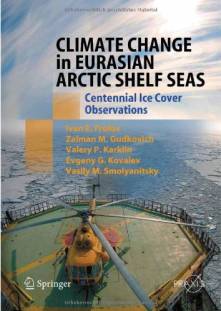 As
the lack of forecasting skill is immense, a new book,
which predict a sea ice rebound, raise interest instantly. Four
Russian experts from the eminent Arctic research facility AAIR
in St. Petersburg investigate the development in Eurasian Arctic
Shelf during the last century concerning climate change and ice
cover observations.
In seven chapters they assess the relevance of the Arctic sea ice on
climate during the 20th Century, possible causes of
changes and how the future may look like in the 21st
Century, with a two page long summary.
The
book is to recommend to anyone who is interested to get an overview
of the parameters which may play a role for assessing the mechanism
that drive the conditions in the Arctic.
A book review, by A.
M. Hamza, (Here)
regards. “The data harvested from the Eurasian Arctic shelf seas
might be very useful for scientists, and … . in Summing Up:
Recommended. … Upper-division undergraduates through professionals
in environmental sciences.”
The
book-blurb highlights particularly:
____”In the first two chapters, they show that multi-year
changes of the sea-ice extent in the Arctic Seas were formed by
linear trends and long-term (climatic) cycles lasting about 10, 20
and 60 years. The structure of temporal variability of the western
region (Greenland – Kara) differs significantly from the eastern
region seas (Laptev and Chukchi). In the latter region, unlike the
former area, relatively short-period cycles (up to 10 years)
predominate. The linear trends can be related to a super-secular
cycle of climatic changes over about 200 years. The most
significant of these cycles, lasting 60 years, is most pronounced
in the western region seas.” (Here)
Whether
the book’s focus on the sea ice is a good idea to assess the
source of climate change conditions in the Arctic is doubted, as sea
ice extent and thickness seem to offer little on climatic cycles
(Ch. 2 & 3). The approach gains substance when atmospheric and
hydrospheric processes (Ch.4), and subsequently the possible causes
of changes in climate and Arctic sea ice extent (Ch.5) are discussed,
including the widely discussed impact of CO2 and solar activities.
Little attention has been paid to quite different temperature
deviation from long-term means between the summer and winter season.
For example, the Arctic warming from 1919 to 1939, was actually a
warming during the winter season, which indicates that the influence
of CO2 concentration and sun activities had a minor, or a different
role in any observed changes, due to the long polar night from
October to March. During the winter season the Arctic Ocean and the surrounding sea areas determine the
weather conditions, and changes of climatic pattern. This is in no way reflected
when the book concludes: "Over the period it seems possible
that solar variations were the prime factor in climate change"
(Conclusion, item 12).
As
Frolov et al. investigated the 20th century, they should have taken
the time to analyse what their predecessors had to say. But the
discussion during the 1930s is completely ignored. None of
the significant papers e.g. Birkeland (1930), O.V. Johannsson
(1936), R. Scherhag (1936, 1937, 1939),
C.E.P. Brooks (1938); Carruthers (1941), Manley (1941) is
mentioned, nor the paper by Schokalsky, J. (1936); ‚Recent Russian
researches in the Arctic Sea and the in mountains of Central Asia’,
in: The Scottish Geographical Magazine, Vol. 52, No.2, March 1936,
p. 73-84; (for details see Ch. 3 (b), p. 30, at:
http://www.arctic-heats-up.com/chapter_3.html
) who at that time was President of the Geographical Society of the
Soviet Union.
Most unfortunate, from the viewpoint of the reviewer,
is the little interest, if not ignorance, the authors have shown for
the oceanic influence. They explain the various parameters (Ch.4.6)
but remain largely inexplicit on what to make out of the available
data and observations. They mention the research of
V.F. Zakharov(Ch 4.1), and that „he
was also able to explain localization of the most significant
changes in the sub-Atlantic Arctic“, but actually do not answer a
question that V.F. Zakharov (1997)
raised a decade ago:
-
Why
are the maximum climate fluctuations confined to the Atlantic
sector of the Arctic?
-
Why
are these fluctuations pronounced, first of all, right here?
-
Should
the Atlantic sector of the Arctic be considered as a center of
some kind, a source of climate change over the hemisphere?
The
answer is that the first Arctic warming from 1919 t0 1939 was
generated in the sea area between Spitsbergen and the Fram Strait,
which has been analysed in the book “Arctic Heats Up” (2009, p.
106) at: http://www.arctic-heats-up.com
.
However,
Ivan E. Frolov et al. are explicit with regard to climate models
(Ch. 5.1) (excerpt):
“___There
are large discrepancies in the results of simulations of climate
change using coupled atmosphere-ocean models, which testifies to the
uncertainties inherent in the models,
___These models are unable to simulate real historical climate
changes…“,
summarizing
in the Conclusion (item 14):
___”Many
climatologists have concluded that anthropogenic factors burning
of fossil fuels, deforestation and other processes exert a strong
influence on global warming in the 20th century. This was based on
coupled –model simulations of the general circulation of the
ocean, atmosphere, and ice cover. However, these models do not
appear to reflect the cyclic features of variations in Arctic ice
extent and climate”.
Finally
Frolov et al. object the view that the recent rapid warming of polar
temperatures and shrinking of multi-year Arctic sea ice are highly
unusual compared to events from previous thousands of years, but
forecast (Conclusion, item 15): “that continuing natural cyclic
changes will bring about both decrease and increases in the ices
extent of Arctic Ocean marginal seas.”
As
much as the positive forecast is very welcome, it must be
acknowledged that it is based on the assumption that the findings on
Arctic cycles do indeed allow to extrapolate the cycles forward into
the 21st century. Whether that will work, may be known in
a distant future only.
By: Arnd-Bernaerts/20 Oct.2010
Blog:
Oct.16, 2010: http://wattsupwiththat.com/2010/10/16/arctic-ice-rebound%C2%A0predicted/
Frolov, I.E., Gudkovich, Z.M.,
Karklin, V.P., Kovalev, E.G., Smolyanitsky, V.M. (2009);
“Climate Change in Eurasian Arctic Shelf Seas - Centennial Ice
Cover Observations” , Berlin & Chichester, pages 176.
The seven chapters:
__1. Arctic sea ice as an element of the global climate system
(p.1-5)
__2. Long-term changes in the Arctic Seas ice extent during the
twentieth century (p.7-23)
__3. Variability of sea ice thickness and concentration in the
twentieth century (p.29-35)
__4. Consistency among sea ice extent and atmospheric and
hydrospheric processes (p.37-83)
__5. Possible causes of changes in climate and Arctic Seas ice
extent (p.89-108)
__6. Assessment of possible changes in air temperature and
sea-ice extent in the Arctic Seas in the twenty-first century
(p.113-117)
__7. Conclusions (p.131-133),
__ Appendix A, B & C (p.134-144) ;
References (p.145-164)
Zakharov, V.F. (1997) ‘Sea Ice in the Climate
System’, Arctic Climate System Study, WMO/TD-No. 782, p.70f.


