A
chill from the ocean?
Did
the North Atlantic cool down 1968-1972?
Posted here: 24 September 2010
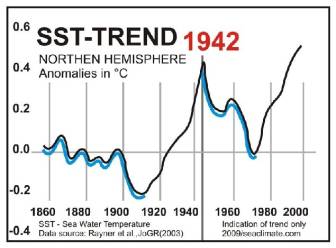 Does
the science magazine NATURE go for the ‘ocean’ in
climatic research matters? A glimpse of hope comes up
when reading the paper title: “An abrupt drop in
Northern Hemisphere sea surface temperature around
1970”, (23
Sept.2010, Vol. 467). The authors (Thompson et al.
) asses that the twentieth-century trend in global-mean
surface temperature was not monotonic: temperatures rose
from the start of the century to the 1940s, fell
slightly during the middle part of the century, and rose
rapidly from the mid-1970s onwards. They conclude, that
the “hemispheric differences in temperature trends in
the middle of the twentieth century stem largely from a
rapid drop in Northern Hemisphere sea surface
temperatures of about 0.3 °C
between about 1968 and 1972”: Does the reference to
sea surface temperatures (SST) marks the beginning of a
better understanding of what drive the climate?
The hope stems from a supporting
article by the Nature writer Quirin Schiermeier, also
in Vol 467, by recognising that “for climate
researchers, the discovery that a large patch of the
ocean cooled by 0.3 °C within a few years around 1970
is a small sensation.” Both texts have been quickly
picked up in the blog-sphere, and to some I submitted
comments.
NATURE___(#14134) http://www.nature.com/news/2010/100922/full/467381a.html
· 2010-09-23 05:47:32 AM , · Posted by: Arnd Bernaerts
The
research goes in the right direction. The ocean need
more attention, and a “large patch” of slightly
colder water (0,3°C) in the North Atlantic, can have a
similar and a longer lasting effect (from about 1968 -
1972) as an El Nino, or La Nina event in the Central
Pacific. What surprises that the researcher seem to
assume that they can isolate this few years from the
evident NH cooling that started in the early 1940s, in
Europe definitely in winter 1939/40, (http://climate-ocean.com/
) lasting to the mid 1970s. Since September 1939
“large ocean and sea patches in Europe had been
subject to naval war activities, which subsequently
covered the North Atlantic and Pacific for four years
from December 1941 to summer 1945. SST and SAT dropped
for about three decades until the period 1968-1972 which
came at the end of the only “global cooling” period
since the end of the Little Ice Age (about 1850).
NATURE___(# 14354) http://www.nature.com/news/2010/100922/full/467381a.html
· 2010-09-23 10:00:20 AM , · Posted by: Arnd Bernaerts
RE: Stephen Wilde.
Cooling and warming is
controlled by the ocean, and solar variability has never
challenged this control, as over millions of years the
global mean temperatures have been kept in a narrow band
of a few degrees, which is different from, e.g. , the
conditions on the moon due to lack of water.
Even the most prominent known oceanic event, the El
Nino, derive presumably from an internal mechanism. Dake
Chen et al (Nature, Vol. 428, 2004) assumes:
“THE implication is that the evolution of major
ENSO events is largely determined by oceanic initial
conditions, and that the effect of subsequent
atmospheric noise is generally secondary.”
Discussed at: Ch.2, p.23f;
http://climate-ocean.com/02_12-Dateien/02_12.html
One
can only hope that the Thompson et al. Nature paper that
has been give the attribution of a small sensation is
indeed opening a new chapter in climate research, for
which I suggested in a letter to Nature almost two
decade ago, to define: CLIMATE as the continuation of
the oceans by other means.
(NATURE 1992, ‘Climate Change’, Vol. 360, p. 292),
in detail discussed at :
http://www.whatisclimate.com/

NEW
YORK TIMES___http://dotearth.blogs.nytimes.com/2010/09/22/a-sharp-ocean-chill-and-20th-century-climate/
26.
ArndB, Hamburg, September 23rd, 2010, 8:41 am
#
Arno Arrak , Dix Hills,
“It started abruptly at the turn of the twentieth
century after a two thousand year, linear, cooling
stretch (Kaufman et al., Science 325:1236-1239).”
The
date can be given very precisely. It was in winter
1918/19 the temperatures exploded at the Fram Strait and
the Spitsbergen region, warming the Arctic (and NH) for two decades until 1940, presumably caused by
warm water from the Gulf Current (West Spitsbergen
Current), after having passed Western Europe or the
North Sea, which had been subject to devastating naval
war activities over a period of four year from 1914 to
1918; see: http://www.arctic-heats-up.com/.
The
two decades warming was succeeded by a three decade
lasting global cool which started in winter 1939/40 and
lasted until about the mid 1970s. It surprises that
Thompson et al correlate a SST drop in the North
Atlantic only towards the end of this period
(1968-1972), although there are good reasons to assume
that the global cooling since 1940 had, from the
beginning, at lot to do with SST changes. http://www.oceanclimate.de/
WATTS UP
WITH THAT (WUWT):
http://wattsupwiththat.com/2010/09/22/ocean-cooling-contributed-to-mid-20th-century-global-warming-hiatus/
ArndB
says: September
23, 2010 at 6:01 am
#
RField
says: September
23, 2010 at 4:44 am
___(1)
”the graph shows a steady warming since 1910”
___(2)
”the drop from 1940”
(1)
The warming during the early 20th Century
only started in winter 1918/19 and in the Arctic,
although it was felt all over the Northern Hemisphere
for two decades until World War II commenced in
September 1939. See : http://www.arctic-warming.com/poze/pozaAa.jpg , In detail: http://www.arctic-heats-up.com/
(2) There are many indications that a three decades global cooling
started in winter 1939/40, at least in Europe. In 1943
the British scientist A. J. Drummond wrote: “The
present century has been marked by such a widespread
tendency towards mild winters that the ‘old-fashioned
winters’, of which one had heard so much, seemed to
have gone for ever. The sudden arrival at the end of
1939 of what was to be the beginning of a series of cold
winters was therefore all the more surprising,”
(in QJoR
Met. Society, 1943),
more at: http://www.oceanclimate.de/A_Large_Scale_Experiment_with_Climate/A_Large_Scale_Experiment_with_Climate.html
Even
J.
Hansen
et al (Science, 1981) does not object the mid century
cold period : ‘In fact, the temperature in
the Northern Hemisphere decreased by about 0.5°C
between 1940 and 1970….’. Although there are good
reasons to assume that the oceans and seas played a
major role in the cooling event since it commenced in
winter 1939/40, http://climate-ocean.com/
, Thomson
et al. identify only the time period from 1968-1972 for
a significant oceanic contribution, but which marks only
the very end of the global cooling period. This is a far
to narrow approach, and any research should cover
the full earth cooling period from 1940 to the
mid 1970s.


